

Roughing End Mill 4-Flute HSS CHUOKU — Fast Stock Removal
Description
Roughing End Mill 4-Flute HSS CHUOKU — Fast Stock Removal
The CHUOKU 4-flute roughing end mill in high-speed steel (HSS) has a serrated, wavy cutting edge that breaks chips into small pieces and removes stock faster and deeper than a plain end mill, with less vibration and heat build-up. Ideal for milling mild steel, tool steel, and cast iron on milling machines and CNC. Available from φ6 to φ25 mm. Supplied by BOWMAP Industry & Tooling, Samut Prakan.
Specifications
| Brand | CHUOKU |
|---|---|
| Type | Roughing end mill, serrated (wavy) edge |
| Flutes | 4 (4F) |
| Material | High-speed steel (HSS); carbide version available |
| Size range | φ6–φ25 mm |
| Example φ6 mm | Shank 10 · flute 16 · OAL 66 mm |
| Example φ12 mm | Shank 12 · flute 26 · OAL 83 mm |
| Example φ20 mm | Shank 20 · flute 38 · OAL 104 mm |
| Cutting speed (mild steel) | HSS 21–30 · carbide 45–75 m/min |
| Cutting speed (aluminium) | HSS 150–300 · carbide 300–600 m/min |
Use cases
- Heavy roughing — removing large amounts of stock before finishing
- Slotting, shouldering, and opening up mild steel and tool steel
- Milling on vertical mills, horizontal mills, and CNC
- Mould work and parts production needing fast cycle times
- General milling of cast iron, bronze, and aluminium
Compatibility
Match the shank size (6/10/12/16/20 mm by cutter size) to your collet or end-mill holder. The serrated edge of a roughing cutter is made for fast stock removal; follow with a plain end mill for a smooth final surface. Use coolant and set speeds and feeds to the material to extend tool life.
Availability
In stock at the BOWMAP warehouse in Samut Prakan, ready for same-day pickup or next-day delivery across Bangkok and the surrounding provinces. Contact us for bulk pricing on large orders.
Related products
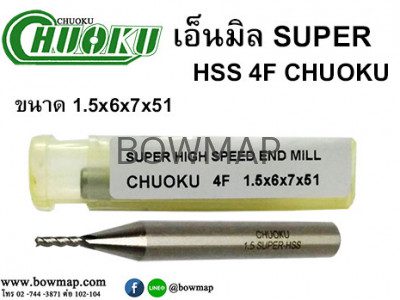
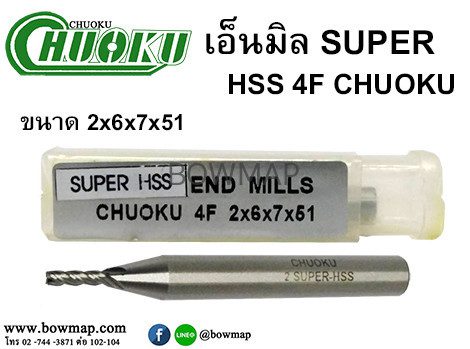
- CHUOKU Super HSS end mill 4F
- CHUOKU titanium-coated end mill
- BISCHUFOUR carbide end mill
- Collets / end-mill holders
FAQ
How is a roughing end mill different from a plain end mill?
A roughing end mill has a serrated, wavy edge that cuts chips into small pieces, clears chips and heat well, and removes stock faster and deeper — but leaves a rougher surface. A plain end mill gives a smoother finish for finishing passes. The usual approach is to rough with a roughing end mill, then finish the surface with a plain end mill.
Should I choose HSS or carbide?
HSS roughing end mills are tough, impact-resistant, and economical — good for general mills and mild steel. Carbide is harder and more heat-resistant, runs at nearly double the cutting speed, and suits high-volume production and hard materials, but it is more brittle and needs a rigid machine.
Why does the cutting edge chip?
The main causes are too high a feed per tooth, excessive heat build-up, or the workpiece work-hardening during the cut. Clamp the cutter shank firmly, set speeds and feeds to suit the material, and use coolant to help carry away heat.