Carbide vs HSS: When Each Is Actually Worth the Money
A carbide insert costs several times what an HSS tool bit does, so the cautious shop reaches for HSS and the well-funded one buys carbide for everything — and both can be wrong. The real question is never "which is better?" but "which is cheaper per finished part on this machine, for this job?" Answered that way, carbide and HSS each win clearly in different situations, and buying the wrong one either wastes money on tooling that chips, or wastes far more money on machine time crawling through a job.
This guide is for the owner, buyer, or engineer deciding where to spend on cutting tools. We'll compare the two materials honestly, show how cost-per-part — not sticker price — decides it, and give a simple framework for choosing.
What actually differs
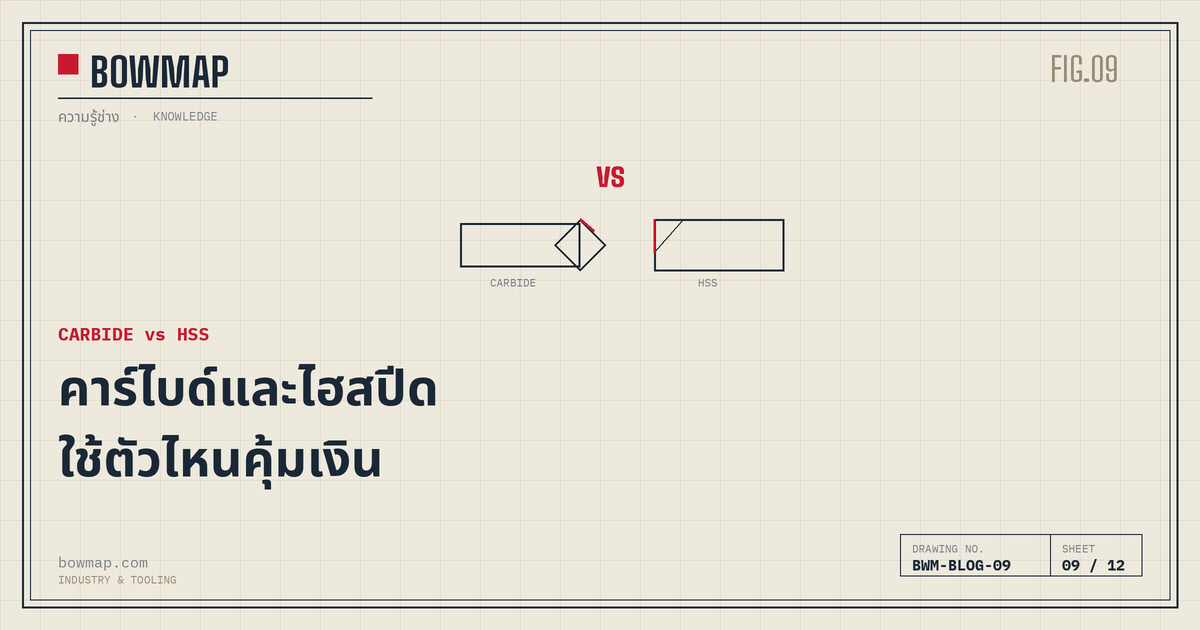
HSS (high-speed steel) and tungsten carbide are not better or worse — they're different trades of hardness against toughness.
| Property | HSS (incl. cobalt super-HSS) | Carbide |
|---|---|---|
| Hardness / heat resistance | Good; softens above ~600 °C | Excellent; cuts hot, holds edge at high speed |
| Cutting speed | Lower | 3–5× higher |
| Toughness | Tough — tolerates shock, flex, interrupted cuts | Brittle — chips on impact or vibration |
| Edge life (right conditions) | Shorter | Much longer |
| Sticker price | Low | High |
| Re-sharpening | Easy, on a bench grinder | Needs diamond; inserts are indexed/replaced |
| Forgiving of a weak setup | Yes | No — needs rigidity |
The headline: carbide is harder and faster but brittle and fussy; HSS is softer and slower but tough and forgiving. That single trade-off drives every sensible buying decision.
Cost-per-part, not sticker price
A carbide tool can cost five times an HSS one and still be cheaper overall, because the number that matters is total cost spread across the parts it makes:
Cost per part ≈ (tool + regrind cost ÷ parts per edge) + (machine time × rate)
On a rigid machine running volume, carbide's higher cutting speed slashes the machine-time term — often the biggest cost — while its longer edge life spreads the higher tool price across many more parts. The expensive tool wins decisively. A TiAlN carbide end mill orK10F carbide plate for brazing onto turning tools pays for itself fast when the spindle is earning money every minute.
But flip the conditions and the maths flips too. For a one-off part, a short run, an interrupted or shock-loaded cut, or a worn manual lathe that can't feed carbide fast enough or hold it rigidly, the carbide edge chips early — and a chipped carbide tool makes zero parts for its high price. Here an HSS bit you can grind to shape in two minutes and re-sharpen for free is far cheaper per part. A set of HSS lathe tool bits is the economical choice for manual turning, odd jobs, and tricky materials.
A simple framework
Three questions decide it almost every time:
- Is the machine rigid? Solid CNC or heavy lathe with no chatter → carbide can run at speed. Worn manual machine, light bench lathe, or flexy setup → HSS, which tolerates the flex.
- What's the volume? Hundreds or thousands of identical parts → carbide's speed and life win on cost-per-part. One-offs and short runs → HSS, where grinding your own tool is faster and cheaper than buying a special.
- Is the cut continuous? Smooth, continuous cuts suit carbide. Interrupted cuts (slots, flats, castings with scale) shock-load the edge and favour tough HSS — or a tougher carbide grade run conservatively.
There's also a material angle. Hardened steel and high-temperature alloys essentially require carbide (or beyond), because they're harder than HSS can cut. Soft, gummy, or abrasive materials and general manual work are happy on HSS. A carbide turning tool handles the hard and high-speed jobs; ground HSS covers everything forgiving.
A worked example
Numbers make the point. Say a part takes 5 minutes of cutting with an HSS tool but only 1.5 minutes with carbide on a rigid machine, at a shop rate of 600 THB/hour. The HSS bit costs 80 THB and makes 40 parts between re-grinds; the carbide edge costs 250 THB and lasts 200 parts.
- HSS: tool 80 ÷ 40 = 2 THB/part, plus machine time 5/60 × 600 = 50 THB → 52 THB/part.
- Carbide: tool 250 ÷ 200 = 1.25 THB/part, plus machine time 1.5/60 × 600 = 15 THB → about 16 THB/part.
Carbide wins roughly three to one — but only because the rigid machine let it run at speed and reach 200 parts. Put that same insert on a worn manual lathe where it chips at 10 parts and crawls at 4 minutes a part, and the maths inverts: tool 250 ÷ 10 = 25 THB, plus 40 THB machine time = 65 THB/part , now worse than the HSS it replaced. The tool didn't change — the machine did. That is the whole argument in one calculation: carbide's price is repaid by speed and edge life, and a machine that can't deliver either turns the cheap-looking carbide into the expensive option.
The honest summary: most shops shouldn't standardise on one. Keep carbide for the rigid, high-volume, hard-material, continuous work where it earns its price, and HSS for manual machines, one-offs, interrupted cuts and grind-your-own tooling. Choosing per job, not per preference, is what actually controls tooling cost.
BOWMAP Industry & Tooling, a Samut Prakan supplier of Japanese-quality industrial tools, stocks HSS and cobalt super-HSS tooling alongside carbide inserts, end mills and brazing plate, so a workshop can put carbide where it pays and HSS where it saves rather than forcing one everywhere.
FAQ
Q1. Is carbide always better than HSS? No. Carbide is harder, faster and longer-lasting on a rigid machine, but it's brittle and chips on shock, vibration, or a weak setup. HSS is tougher, cheaper, re-sharpenable, and forgiving of manual machines and interrupted cuts. "Better" depends entirely on the machine, the volume, and the cut — neither wins everywhere.
Q2. Why does carbide chip on my manual lathe? Because carbide needs rigidity and speed it isn't getting. A worn or light manual lathe flexes and can't run carbide at the high surface speed it's designed for, so the brittle edge sees vibration and low-speed rubbing and chips. On that machine, ground HSS bits will outlast carbide and cost far less.
Q3. How can the more expensive carbide tool be cheaper overall? Because cost-per-part includes machine time, not just the tool. On a rigid machine carbide cuts several times faster and lasts much longer, so it spreads its price over many more parts and slashes the dominant machine-time cost. Over a production run the expensive tool wins clearly — but only when the machine can actually exploit its speed.
Q4. Which should I buy for general manual turning? HSS, usually cobalt "super-HSS" bits you grind to shape. They're cheap, tough, re-sharpenable, and forgiving of the flex and interrupted cuts of a manual lathe. Keep carbide for hardened materials, high-speed continuous work, or production volume where its speed and edge life pay for the higher price.