End Mill Selection: Roughing vs Finishing, Flutes and Coatings
Two end mills sit in the drawer that look almost identical — same diameter, same shank — but one clears a steel pocket in a third of the time and the other leaves a finish you could measure with a gauge. Pick wrong and you either crawl through a roughing job with a finishing tool, or chew up an expensive cutter trying to hog metal it was never built to move. End mill selection is where a lot of machining time and tooling money quietly leaks away, and the choices are not complicated once you know what each feature is actually for.
This guide is for the machinist or engineer choosing end mills for a milling machine or machining centre. We'll cover roughing versus finishing geometry, how flute count changes the cut, what the coatings do, and when carbide earns its price over HSS.
Roughing vs finishing — two different jobs
The first decision is what the cutter is for , because roughing and finishing end mills are built to opposite priorities.
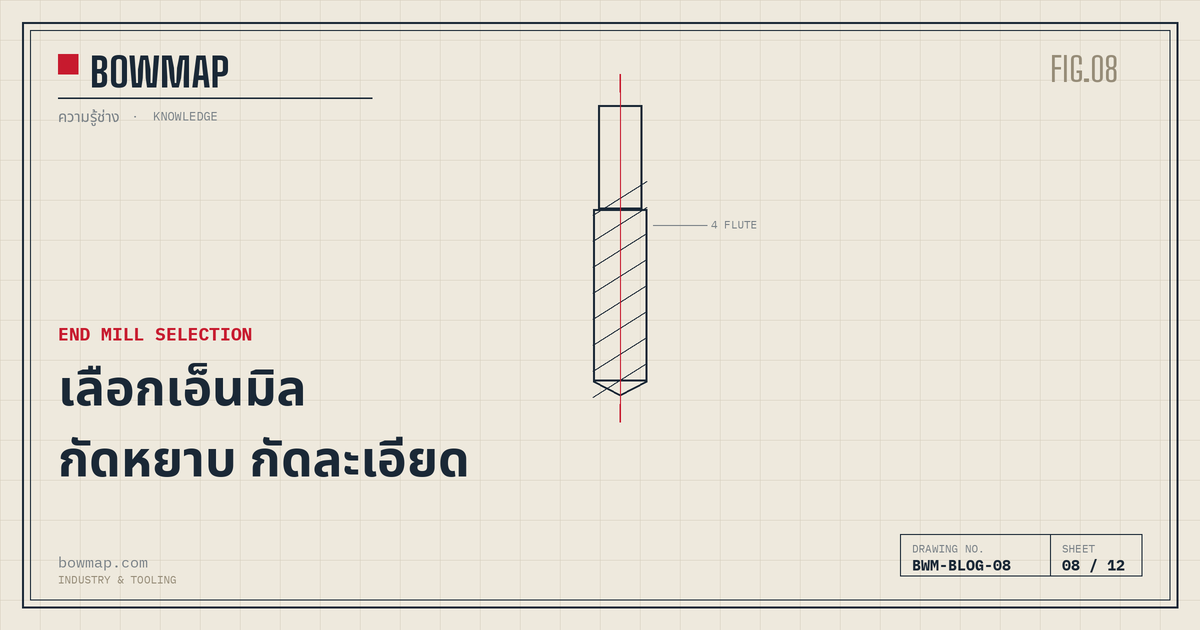
roughing end mill (the "rippa" or corn-tooth type) has serrated cutting edges that break the chip into small pieces. That lets it take a deep, heavy cut with far lower cutting force and much better chip evacuation than a smooth cutter — it removes metal fast. The trade-off is a rough, scalloped surface, so it is never the final pass. A 4-flute HSS roughing end mill is the tool for hogging out pockets and slots quickly before you switch to a finisher.
finishing end mill has smooth flutes and a sharp, accurate edge that leaves a clean, dimensionally true surface in a light final pass. The standard workflow is rough first to within a small margin (say 0.3–0.5 mm), then take a light finishing pass with a finishing cutter for size and surface. Trying to do both jobs with one tool is the slow, expensive way.
Flute count changes everything
The number of flutes is the most misunderstood spec. More flutes is not "better" — it's a trade between chip room and rigidity/finish.
| Flutes | Best for | Why |
|---|---|---|
| 2 | Aluminium and non-ferrous, slotting, plunging | Big chip gullets clear gummy chips; won't pack and weld |
| 3 | Aluminium slotting with a better finish | Compromise — more chip room than 4, smoother than 2 |
| 4 | Steel and stainless, side milling, finishing | More cutting edges per turn = better finish and rigidity |
| 6+ | Light finishing, hardened materials | Many fine cuts, but almost no chip room — not for slots |
The core rule: few flutes for soft, gummy materials and deep slots (chip clearance wins); more flutes for steel and finishing (rigidity and finish win). Aluminium with a 4-flute cutter in a deep slot packs chips and snaps the tool; steel with a 2-flute finisher leaves a poorer finish and deflects more. A 4-flute super-HSS end mill is the general-purpose steel-milling choice for shops running manual or lighter machines.
Coatings: what the colours mean
A coating is a thin, hard, heat-resistant film that lets the cutter run faster, hotter and longer. The common ones:
| Coating | Looks | Best for |
|---|---|---|
| Uncoated | Plain HSS/carbide | Aluminium and brass (coatings can make alu stick) |
| TiN (titanium nitride) | Gold | General purpose, mild steel, a solid all-rounder |
| TiCN (titanium carbonitride) | Blue-grey | Harder and more wear-resistant; abrasive materials |
| TiAlN / AlTiN (aluminium titanium nitride) | Dark grey/violet | High heat — hardened steel, stainless, dry and high-speed cutting |
The one that matters most for steel is TiAlN/AlTiN : at cutting temperature it forms a thin aluminium-oxide layer that protects the edge from heat, so it excels in hard steel, stainless, and dry or high-speed work. A TiAlN-coated 2-flute carbide end mill handles hardened and stainless steel at speeds that would burn an uncoated tool. For aluminium, though, leave coatings off or use a polished/ZrN tool — aluminium tends to stick to TiN-type coatings and build up on the edge.
Carbide vs HSS — match the tool to the machine
Coating aside, the body material decides where a cutter belongs:
- Carbide is far harder and more heat-resistant, holds its edge at high speed, and gives better finish and tool life — but it is brittle and unforgiving. It needs a rigid machine, tight workholding, and no chatter; on a worn manual mill or an interrupted cut it chips. Carbide is the right choice on a rigid CNC running production.
- HSS and cobalt "super-HSS" are tougher and far cheaper. They tolerate the flex, vibration and interrupted cuts of manual machines and one-off work, and they're the sensible choice when rigidity isn't guaranteed or when a crash would write off an expensive carbide cutter.
The practical reading: rigid CNC and volume → carbide; manual mill, light machine, or shock-loaded cuts → super-HSS. Many shops keep both and choose per job rather than buying one type for everything.
Run the cutter at the right speed and feed for its material and diameter, climb-mill where the machine has no backlash for a better finish, and keep chips cleared — a recut chip is a common way to chip any end mill, carbide or HSS.
BOWMAP Industry & Tooling, a Samut Prakan supplier of Japanese-quality industrial tools, stocks roughing and finishing end mills in HSS, cobalt super-HSS and coated carbide, so a machinist can match flute count, coating and body material to the material, the operation and the machine.
FAQ
Q1. How many flutes should an end mill have? Match flutes to the material and operation: 2 flutes for aluminium and non-ferrous, slotting and plunging (they clear gummy chips); 4 flutes for steel, stainless, side milling and finishing (more edges give better finish and rigidity). Fewer flutes win when chip clearance matters; more flutes win for finish and rigidity. Don't slot aluminium with a 4-flute cutter — it packs chips and breaks.
Q2. What's the difference between a roughing and a finishing end mill? A roughing (rippa) end mill has serrated edges that break chips, so it removes metal fast at low cutting force but leaves a rough surface. A finishing end mill has smooth flutes that leave a clean, accurate surface in a light pass. The workflow is rough close to size, then take a light finishing pass — one tool can't do both jobs well.
Q3. Which end mill coating is best for hardened or stainless steel? TiAlN or AlTiN. At cutting temperature it forms an aluminium-oxide layer that shields the edge from heat, so it excels in hardened steel, stainless, and dry or high-speed cutting. TiN is a fine general-purpose coating for mild steel; for aluminium, run uncoated or polished, because aluminium sticks to TiN-type coatings.
Q4. Carbide or HSS end mill — which should I buy? It depends on the machine. Carbide is harder, faster and lasts longer but is brittle and needs a rigid setup — ideal on a solid CNC. HSS and cobalt super-HSS are tougher and cheaper and tolerate the flex and interrupted cuts of manual or lighter machines. Rigid CNC and volume: carbide. Manual mill or shock-loaded work: super-HSS.