Lathe Chuck Setup: Killing Runout on 3-Jaw and 4-Jaw Chucks
You face off a bar, flip it to machine the other end, and the part comes out with a step you can feel — the second setup didn't run true. Or a finished shaft wobbles visibly in the chuck and the dial indicator swings a tenth of a millimetre when it should barely move. That wobble is runout , and it quietly wrecks concentricity, finish, and tolerance on more lathe work than any tool problem. The good news is that most runout comes from a short list of fixable causes, and the rest is a setup skill anyone can learn.
This guide is for the machinist or apprentice chasing accuracy on a lathe. We'll explain where runout comes from, the real difference between a 3-jaw and a 4-jaw chuck, and how to dial a part in to near-zero.
What runout is, and where it comes from
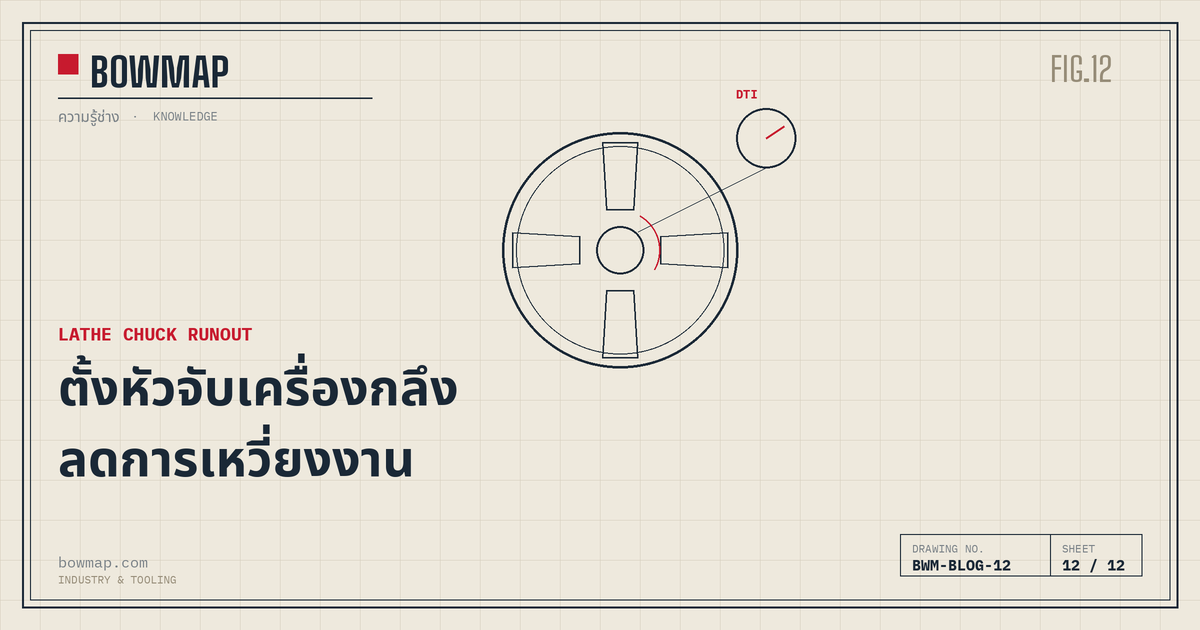
Runout is how far the work's axis wanders from the spindle's axis as it turns — measured with a dial test indicator against the surface while you rotate the spindle by hand. A few hundredths of a millimetre is normal on a self-centring chuck; a tenth or more means something is wrong. The usual causes:
- Swarf or dirt behind the jaws or in the scroll. The single most common cause — a chip trapped between the jaw and the work, or packed in the chuck body, pushes everything off-centre. Clean first, always.
- Worn scroll in a 3-jaw chuck. The spiral scroll that drives all three jaws wears with use, and a worn scroll no longer centres perfectly. This runout is built in and can't be dialled out on that chuck.
- Jaws fitted in the wrong order. A 3-jaw's jaws are numbered and must go into their matching numbered slots in sequence — fit them wrong and the chuck won't centre at all.
- Bellmouthing and gripping on a short length. Jaws gripping only at their tips, or on too little length, let the part tilt and run out.
- Spindle or backplate error. Less common, but a damaged spindle nose or a chuck not seated true on its backplate puts runout into everything.
3-jaw vs 4-jaw — the real difference
The two chucks aren't better and worse; they're built for opposite priorities.
| 3-jaw self-centring | 4-jaw independent | |
|---|---|---|
| Centring | Automatic — all jaws move together | Manual — each jaw adjusts separately |
| Speed | Fast: grip and go | Slow: dial each piece in |
| Runout | Built-in (0.05+ mm typical, worse as it wears) | Near-zero — you set it as true as you like |
| Best for | Round stock, quick repeatable work | Precision, off-centre, square or odd shapes |
3-jaw self-centring chuck is fast and fine for most round work where a few hundredths of runout don't matter, but its accuracy is fixed by the scroll and degrades as it wears — you cannot adjust it true. A 4-jaw independent chuck lets you move each jaw on its own, so you can dial a part to almost perfect concentricity (or deliberately off-centre), at the cost of a slower setup. Precision work, second-operation truing, square stock, and worn-out 3-jaw accuracy are all reasons to reach for the 4-jaw. A set of 3-jaw and 4-jaw lathe chucks covers both the fast everyday work and the jobs that need true running.
Dialing in a 4-jaw to near-zero
This is the core skill. With the part lightly held in the four jaws:
- Set a dial test indicator against the outside of the work near the chuck.
- Rotate the spindle slowly by hand and find the high spot (where the needle reads maximum).
- At the high spot, slightly loosen the jaw on that side and tighten the opposite jaw , moving the part toward centre.
- The professional shortcut: adjust to halve the error. If the indicator swings 0.20 mm, move the part until the high and low readings are 0.10 mm apart, then repeat. Each pass roughly halves the runout.
- Repeat across both jaw pairs until the needle barely moves, then nip all four jaws evenly to final grip.
Work methodically on opposing pairs, don't over-tighten until you're centred, and you'll bring most parts inside a couple of hundredths in a few minutes. Verify the result the same way you'll check the finished part — a digital vernier caliper confirms outside diameters across the work, and adial bore gauge checks that a bored hole is round and on-size once the part runs true.
Habits that keep work true
Even a good chuck runs out if you fight it. Clean the chuck and jaws every setup — wipe the jaws, blow out the scroll, and check nothing is trapped behind the work; this alone fixes most runout complaints. Grip on enough length so the part can't tilt, and where possible grip on a turned (not as-sawn) surface. For repeat precision on a 3-jaw, fit and bore soft jaws to the exact diameter so they grip true to that part. And keep a 3-jaw for what it's good at — fast round work — while reaching for the 4-jaw the moment the job actually needs concentricity, rather than fighting a worn scroll.
BOWMAP Industry & Tooling, a Samut Prakan supplier of Japanese-quality industrial tools, stocks 3-jaw and 4-jaw lathe chucks alongside dial indicators, bore gauges and calipers, so a workshop can grip fast when speed matters and dial true when accuracy does.
FAQ
Q1. What's the most common cause of chuck runout? Trapped swarf or dirt — a chip caught between a jaw and the work, or packed in the chuck body and scroll, pushes the part off-centre. Always clean the jaws, the work, and the scroll before blaming the chuck. After that, a worn scroll in a 3-jaw is the next most common cause, and that runout is built in.
Q2. When should I use a 4-jaw chuck instead of a 3-jaw? Use a 4-jaw whenever you need real concentricity — precision work, truing a part for a second operation, gripping square or odd shapes, or when your 3-jaw has worn and no longer runs true. The 3-jaw is faster for everyday round stock; the 4-jaw is slower to set but you can dial it to near-zero runout.
Q3. How do I dial a part true in a 4-jaw chuck? Put a dial indicator on the work, rotate by hand to find the high spot, then loosen the jaw on that side and tighten the opposite one to move the part toward centre. Adjust to halve the error each pass — if it swings 0.20 mm, get it to 0.10, then repeat across both jaw pairs until the needle barely moves, then grip evenly.
Q4. Why can't I fix runout on my 3-jaw chuck? Because a self-centring 3-jaw centres through a single scroll that drives all three jaws together — you can't move one jaw independently, so once the scroll wears, the built-in runout can't be adjusted out. Clean it and fit the jaws in their numbered order first; if it still runs out, bore soft jaws for the part, or use a 4-jaw for that job.